
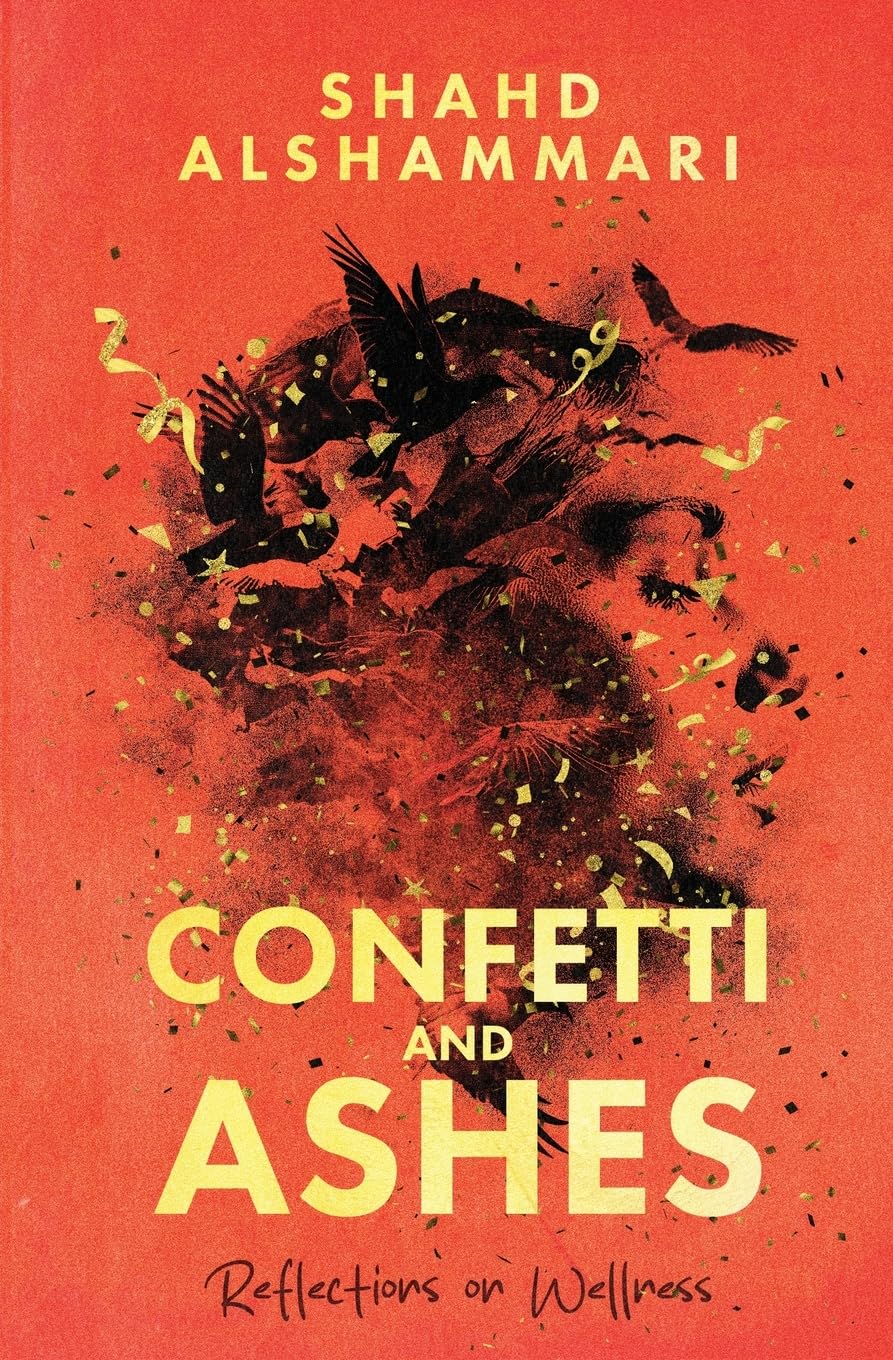
Book Review of CONFETTI AND ASHES by Shahd Alshammari.
Reviewed by Mandy Fessenden Brauer, 5 March, 2025
As author, Dr. Shahd Alshammari writes in the afterward: “CONFETTI AND ASHES – REFLECTIONS ON WELLNESS explores the genre of life narratives and speculative non-fiction” by reimagining “a world where illness and wellness blend perfectly to reveal the resilience of human and non-human spirits.” What an extraordinary book! I expected it to be about pain and suffering but that part, while heartbreaking, is overwhelmed by the positivity that is infused throughout this amazing work. Dr. Alshammari has had severe and troubling Multiple Sclerosis since she was a teenager but has managed, through sheer, tenacious perseverance, to do what was considered impossible. Previously, Dr. Alshammari has chronicled her life with M.S. in NOTES ON THE FLESH and HEAD ABOVE WATER: REFLECTION ON ILLNESS.
This book, an interesting compilation of prose, poetry and conversations with her little ghost, is an account of the author’s more recent efforts to expand her range of functioning physically, mentally and in all ways. The book takes us through some of her medical trials, antidepressants, meditation, breath work, spirit healers, yoga, regression therapy, hypnotherapy, and stem cell treatment which almost killed her, to her successful ventures into dance and squash, and yes, I am referring to the sport! As an interesting observer of this struggle, the little ghost or demon called Zari gives interesting messages to her host and plays a pivotal but quiet role throughout.
It is hard to categorize this book because it is much more than it appears to be. It is a rich and thought-provoking philosophical commentary on various aspects of life such as: time (which is different for disabled people) the importance of our ancestors , known and unknown (and how what they endured influences us epigenetically and culturally); family and in this instance, her grandmother’s and mother’s loving influence as well as a strong code of family rules (such as: “In this house you will apologize. . . ); on femininity as it pertains to a disabled body but equally relevant as it pertains to a conservative, patriarchal society; the cancel culture; failing or feeling like a failure, issues like trust and forgiveness, overcoming destinies, wellness versus unwellness, and always, very much in the background is this little ghost whose role is sometimes positive and sometimes not. She seems to say what is difficult yet true. That said, at times, though, I couldn’t quite track the relevance of what Zari was adding to the conversation.
Since Dr. Alshammari’s specialization is English literature, this book is laced with literary references. For example, she says, “Faustus had Mephistopheles and I have you, Zari.” Most of the literary references, not listed here in any order, were familiar to me: Jesus, Cain and Able, Shakespeare, Cinderella, Scheherazade, Virginia Woolf, Lord Byron, Narcissus, Christopher Marlow, Victor Hugo, Rumi, and C.S. Lewis. Interestingly, Langston Hughes was not mentioned by name, but there was reference to one of his poems. I was unfamiliar with the name of Aphra Behn who was a writer from the Restoration era, one of the first English women to earn a living through writing and who extended the boundaries of what was considered proper to write about at that time.
So many themes lace this book that is not easy to convey the depth of this work. Trust and mistrust get addressed as does the concept of forgiveness, especially forgiving oneself but also those who are unpleasant or ridiculing. Overall, this book is about Dr. Alshammari learning how to trust and learn that it is all right to play and that she is physically able to do so. And perhaps more important, she doesn’t need to be perfect to enjoy! She does learn to dance and ultimately to play and laugh and to have close friends and to thoroughly enjoy playing squash. To learn these were extremely challenging and at one point she says that she needed to: “breakdown for a breakthrough.” Throughout this book, poetry illuminates aspects found in the text which is particularly true of my favorite poem: Tattoo.
To understand what it means to be a human being, to be a woman, to reach beyond the limits, to connect and have community and to find ways to grow and move freely both physically and emotionally culminates in the author saying in a poem, Character, “We can alter our destiny.” She certainly does! At the end of the book the author says, and since we have made the bumpy journey with her, “I am finally happy.” What an accomplishment and what an incredible book! CONFETTI AND ASHES by Dr. Shahd Alshammari should be read by everyone interested in getting to know an extraordinary woman who authored this book and in expanding their own understanding and appreciation of life.